Totals | Tables | Formatting | Charts | Sparklines
- How Do I Find The Quick Analysis Tool In Excel
- How To Open The Quick Analysis Tool In Excel On Mac
- How To Use The Quick Analysis Tool In Excel On Mac
- How To Get Quick Analysis Tool In Excel On Mac
- How To Find The Quick Analysis Tool In Excel
Use the Quick Analysis tool in Excel to quickly analyze your data. Quickly calculate totals, quickly insert tables, quickly apply conditional formatting and more.
Totals
Instead of displaying a total row at the end of an Excel table, use the Quick Analysis tool to quickly calculate totals.
When I paste in Excel 2013 I get the Quick Analysis Smart Tag How can I get to Paste Options so I can easily adjust the column width? Quick Analysis has its place, but I want to also decide if I am pasting values, formats, ect. When I paste a range of text. Once you get all of these ideas from these great tools, how do you come up with your own list of keywords that will fit in with your account? This is what we are here to go over in Excel. Back in October I wrote about an Excel build out sheet that utilized the formula: ‘Cell A & ” ” & Cell B’ in order to come up with keywords along with.
1. Select a range of cells and click the Quick Analysis button.
2. For example, click Totals and click Sum to sum the numbers in each column.
When you select a range of data, Excel displays a Quick Analysis button in the lower-right corner of the range. But this option can be turned off. To turn on/off the Quick Analysis feature, follow the next steps: 1. Quick Analysis: Whenever you highlight/select any table in Excel there is something called Quick Analysis that appears in the bottom right corner of the selection. Let us deep dive into the features Excel offers to make our analysis easy and quick. Features: Formatting: It uses rules to highlight interesting data. How to Use Text Analysis Tools in Excel: Tutorial. Now that you know more about text analysis, you can start putting it to work using MonkeyLearn, a no-code text analysis platform with a suite of pre-trained text analysis tools. If you want to start using MonkeyLearn to analyze your Excel spreadsheets, follow our tutorial: 1.
Result:
3. Select the range A1:D7 and add a column with a running total.
Note: total rows are colored blue and total columns are colored yellow-orange.
Tables
Use tables in Excel to sort, filter and summarize data. A pivot table in Excel allows you to extract the significance from a large, detailed data set.
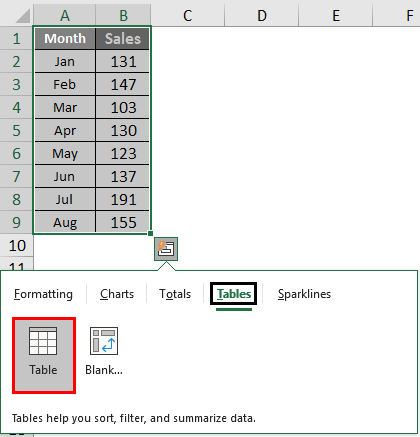
1. Select a range of cells and click the Quick Analysis button.
2. To quickly insert a table, click Tables and click Table.
Note: visit our page about Tables to learn more about this topic.
3. Download the Excel file (right side of this page) and open the second sheet.
4. Click any single cell inside the data set.
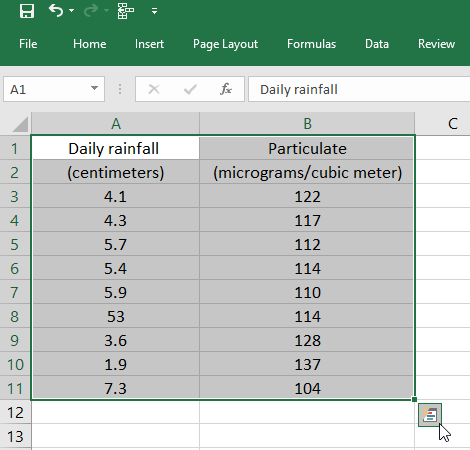
5. Press CTRL + q. This shortcut selects the entire data set and opens the Quick Analysis tool.
6. To quickly insert a pivot table, click Tables and click one of the pivot table examples.
Note: pivot tables are one of Excel's most powerful features. Visit our page about Pivot Tables to learn more about this topic.
Formatting
Data bars, color scales and icon sets in Excel make it very easy to visualize values in a range of cells.
1. Select a range of cells and click the Quick Analysis button.
2. To quickly add data bars, click Data Bars.
Note: a longer bar represents a higher value. Visit our page about Data Bars to learn more about this topic.
3. To quickly add a color scale, click Color Scale.
How Do I Find The Quick Analysis Tool In Excel
Note: the shade of the color represents the value in the cell. Visit our page about Color Scales to learn more about this topic.
4. To quickly add an icon set, click Icon Set.
How To Open The Quick Analysis Tool In Excel On Mac
Note: each icon represents a range of values. Visit our page about Icon Sets to learn more about this topic.
5. To quickly highlight cells that are greater than a value, click Greater Than.
6. Enter the value 100 and select a formatting style.
7. Click OK.
Result. Excel highlights the cells that are greater than 100.
Note: visit our page about Conditional Formatting to learn much more about this topic.
Charts
You can use the Quick Analysis tool to quickly create a chart. The Recommended Charts feature analyzes your data and suggests useful charts.
1. Select a range of cells and click the Quick Analysis button.
2. For example, click Charts and click Clustered Column to create a clustered column chart.
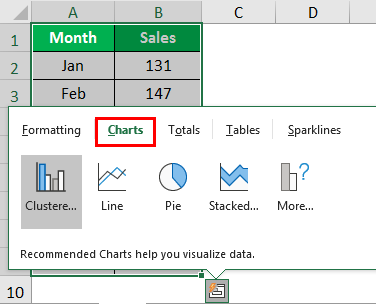
Note: click More to view more recommended charts. Visit our chapter about Charts to learn more about this topic.
Sparklines
Sparklines in Excel are graphs that fit in one cell. Sparklines are great for displaying trends.
1. Download the Excel file (right side of this page) and open the third sheet.
2. Select the range A1:F4 and click the Quick Analysis button.
How To Use The Quick Analysis Tool In Excel On Mac
3. For example, click Sparklines and click Line to insert sparklines.
How To Get Quick Analysis Tool In Excel On Mac
Customized result:
How To Find The Quick Analysis Tool In Excel
Note: visit our page about Sparklines to learn how to customize sparklines.