- Edit Space Between Bullet And Text Word 2016 Pdf
- Edit Space Between Bullet And Text Word 2016 Download
- Edit Space Between Bullet And Text Powerpoint
- Edit Space Between Bullet And Text Word 2016
- Edit Space Between Bullet And Text Word 2016 Free
Right-click in the left-hand Outline pane and choose Show Formatting. Select the bulleted paragraphs in your notes, right-click and choose Paragraphto change the distance of the bullet from the text. Change both amounts in the Indentationsection to the same amount to move the text closer to the bullets.
- Line spacing The space between the lines of the paragraph, defined by setting the height of the lines either in relation to the height of the text (Single, Double, or a specific number of lines) or by specifying a minimum or exact point measurement. The default line spacing for documents created in Word 2016 is 1.08 lines.
- When working with a word document, other than changing the paragraph and line spacing, you also can change the spacing between letters and words. You can change the letter spacing in two ways: Expanded or Condensed. Please see the steps below for details: Step 1: Select the contents you want to increase (or decrease) the letter spacing.
Lesson 14: Indents and Line Spacing
/en/powerpoint2016/lists/content/
Introduction
Indents and line spacing are two important features you can use to change the way text appears on a slide. Indents can be used to create multilevel lists or to visually set paragraphs apart from one another. Line spacing can be adjusted to improve readability or to fit more lines on a slide.
Optional: Download our practice presentation.
Watch the video below to learn more about using indents and line spacing.
To indent text:
Indenting helps to format the layout of text so it appears more organized on your slide. The fastest way to indent is to use the Tab key. An alternative method is to use one of the Indent commands. With these commands, you can either increase or decrease the indent.
- To indent using the Tab key: Place the insertion point at the very beginning of the line you want to indent, then press the Tab key.
- To indent using the Indent commands:Place the insertion point at the very beginning of the line you want to indent. From the Home tab, select the Increase List Level command.
To decrease an indent, select the desired line, then press Shift+Tab or the Decrease List Level command.
Indenting lists and paragraphs
Indenting will give different results, depending on whether you are working with a list or a paragraph.
- Paragraph:Indenting the first line of a paragraph using the Tab key creates a first-line indent. This helps to separate paragraphs from each other, as in the examples above.
- List: Indenting a line of a list creates a multilevel list. This means the indented line is a subtopic of the line above it. Multilevel lists are useful if you want to create an outline or hierarchy.
Once you've created a multilevel list, you may want to choose a different bullet style for different levels of the list to make them stand out even more. Review our lesson on Lists to learn how.
Fine-tuning indents
Sometimes you may want to fine-tune the indents in your presentations. You can do this by adjusting the indent markers on the Ruler. By default, the Ruler is hidden, so you'll first need to show the Ruler.
To show the Ruler:
- Select the View tab on the Ribbon.
- In the Show group, check the box next to Ruler. The Ruler will appear.

Indent markers
Indent markers are located to the left of the horizontal ruler, and they provide several indentation options.
- First-line indent marker: Adjusts the first line of a paragraph
- Hanging indent marker: Adjusts every line of a paragraph except forthe first line
- Left indent marker: Moves both the first-line indent and hanging indent markers at the same time, indenting all lines in a paragraph
To indent using indent markers:
- Place the insertion point anywhere in the paragraph where you want to indent, or select one or more paragraphs.
- Go to the desired indent marker. In our example, we'll use the left indent marker.
- Click and drag the indent marker as needed. When you're done, the selected text will be indented.
Customizing bullet spacing
When working with lists, PowerPoint allows you to fine-tune the space between bullets and text by using the first-line indent marker or the hanging indent marker.
To change the bullet spacing:
- Select the lines you want to change, then go to the desired indent marker. In our example, we'll use the hanging indent marker.
- Click and drag the indent marker as needed. When you're done, the bullet spacing will be adjusted.
Line spacing
PowerPoint allows you to adjust the amount of space between each line in a list or paragraph. You can reduce the line spacing to fit more lines on a slide, or you can increase it to improve readability. In some instances, PowerPoint may automatically change the font size when you adjust the line spacing, so increasing the line spacing too much may cause the text to be too small.
To format line spacing:
- Select the text you want to format.
- On the Home tab, locate the Paragraph group, click the Line Spacing command, then select the desired line spacing option from the menu.
- The line spacing will be adjusted.
If you want to adjust the line spacing with even more precision, select Line Spacing Options from the drop-down menu. The Paragraph dialog box will appear, allowing you to fine-tune the line spacing and adjust the paragraph spacing, which is the amount of space that is added before and after each paragraph.
Challenge!
- Open our practice presentation.
- On the last slide, select the entire bulleted list and change the line spacing options to 12 pt before and 0 pt after.
- Indent the second bullet to make it a subtopic under the first bullet.
- Show the Ruler if it's not already visible.
- For each subtopic, select it and drag the left indent marker to 1 inch (or 2.5 cm). Note: These are the bullets that do not begin with times.
- When you're finished, your slide should look something like this:
/en/powerpoint2016/inserting-pictures/content/
Home > Sample chapters
- 1/11/2016
- Apply paragraph formatting
Documents contain text that conveys information to readers, but the appearance of the document content also conveys a message. You can provide structure and meaning by formatting the text in various ways. Word 2016 provides a variety of simple-to-use tools that you can use to apply sophisticated formatting and create a navigational structure.
In a short document or one that doesn’t require a complex navigational structure, you can easily format words and paragraphs so that key points stand out and the structure of your document is clear. You can achieve dramatic flair by applying predefined WordArt text effects. To keep the appearance of documents and other Microsoft Office files consistent, you can format document elements by applying predefined sets of formatting called styles. In addition, you can change the fonts, colors, and effects throughout a document with one click by applying a theme.
This chapter guides you through procedures related to applying character and paragraph formatting, structuring content manually, creating and modifying lists, applying styles to text, and changing a document’s theme.
Apply paragraph formatting
A paragraph is created by entering text and then pressing the Enter key. A paragraph can contain one word, one sentence, or multiple sentences. Every paragraph ends with a paragraph mark, which looks like a backward P (¶). Paragraph marks and other structural characters (such as spaces, line breaks, and tabs) are usually hidden, but you can display them. Sometimes displaying these hidden characters makes it easier to accomplish a task or understand a structural problem.
You can change the look of a paragraph by changing its indentation, alignment, and line spacing, in addition to the space before and after it. You can also put borders around it and shade its background. Collectively, the settings you use to vary the look of a paragraph are called paragraph formatting.
You can modify a paragraph’s left and right edge alignment and vertical spacing by using tools on the Home tab of the ribbon, and its left and right indents from the Home tab or from the ruler. The ruler is usually hidden to provide more space for the document content.
The left indent can be changed from the Home tab or the ruler
If you modify a paragraph and aren’t happy with the changes, you can restore the original paragraph and character settings by clearing the formatting to reset the paragraph to its base style.
When you want to make several adjustments to the alignment, indentation, and spacing of selected paragraphs, it is sometimes quicker to make changes in the Paragraph dialog box than to click buttons and drag markers.
The Paragraph dialog box
Configure alignment
The alignment settings control the horizontal position of the paragraph text between the page margins. There are four alignment options:
- Align Left This is the default paragraph alignment. It sets the left end of each line of the paragraph at the left page margin or left indent. It results in a straight left edge and a ragged right edge.
- Align Right This sets the right end of each line of the paragraph at the right page margin or right indent. It results in a straight right edge and a ragged left edge.
- Center This centers each line of the paragraph between the left and right page margins or indents. It results in ragged left and right edges.
- Justify This alignment adjusts the spacing between words so that the left end of each line of the paragraph is at the left page margin or indent and the right end of each line of the paragraph (other than the last line) is at the right margin or indent. It results in straight left and right edges.
The icons on the alignment buttons on the ribbon depict the effect of each alignment option.
To open the Paragraph dialog box
Do either of the following:
- On the Home tab or the Layout tab, in the Paragraph group, click the Paragraph dialog box launcher.
- On the Home tab, in the Paragraph group, click the Line and Paragraph Spacing button, and then click Line Spacing Options.
To set paragraph alignment
- Position the cursor anywhere in the paragraph, or select all the paragraphs you want to adjust.
Do either of the following:
- On the Home tab, in the Paragraph group, click the Align Left, Center, Align Right, or Justify button.
- Open the Paragraph dialog box. On the Indents and Spacing tab, in the General area, click Left, Centered, Right, or Justified in the Alignment list.
Configure vertical spacing
Paragraphs have two types of vertical spacing:
- Paragraph spacing The space between paragraphs, defined by setting the space before and after each paragraph. This space is usually measured in points.
- Line spacing The space between the lines of the paragraph, defined by setting the height of the lines either in relation to the height of the text (Single, Double, or a specific number of lines) or by specifying a minimum or exact point measurement.
The default line spacing for documents created in Word 2016 is 1.08 lines. Changing the line spacing changes the appearance and readability of the text in the paragraph and, of course, also changes the amount of space it occupies on the page.
The effect of changing line spacing
You can set the paragraph and line spacing for individual paragraphs and for paragraph styles. You can quickly adjust the spacing of most content in a document by selecting an option from the Paragraph Spacing menu on the Design tab. (Although the menu is named Paragraph Spacing, the menu options control both paragraph spacing and line spacing.) These options, which are named by effect rather than by specific measurements, work by modifying the spacing of the Normal paragraph style and any other styles that depend on the Normal style for their spacing. (In standard templates, most other styles are based on the Normal style.) The Paragraph Spacing options modify the Normal style in only the current document, and do not affect other documents.
The following table describes the effect of each Paragraph Spacing option on the paragraph and line spacing settings.
Paragraph spacing option | Before paragraph | After paragraph | Line spacing |
Default | Spacing options are controlled by the style set | ||
No Paragraph Space | 0 points | 0 points | 1 line |
Compact | 0 points | 4 points | 1 line |
Tight | 0 points | 6 points | 1.15 lines |
Open | 0 points | 10 points | 1.15 lines |
Relaxed | 0 points | 6 points | 1.5 lines |
Double | 0 points | 8 points | 2 lines |
To quickly adjust the vertical spacing before, after, and within all paragraphs in a document
On the Design tab, in the Document Formatting group, click the Paragraph Spacing button to display the Paragraph Spacing menu.
Each paragraph spacing option controls space around and within the paragraph
- Click the option you want to apply to all of the paragraphs in the document.
To adjust the spacing between paragraphs
- Select all the paragraphs you want to adjust.
On the Layout tab, in the Paragraph group, adjust the Spacing Before and Spacing After settings.
The settings in the Spacing boxes are measured in points
To adjust spacing between the lines of paragraphs
- Position the cursor anywhere in the paragraph, or select all the paragraphs you want to adjust.
To make a quick adjustment to selected paragraphs, on the Home tab, in the Paragraph group, click Line And Paragraph Spacing, and then click any of the line spacing commands on the menu.
You can choose from preset internal line spacing options or adjust paragraph spacing
Or
- Position the cursor anywhere in the paragraph, or select all the paragraphs you want to adjust.
- Open the Paragraph dialog box. On the Indents and Spacing tab, in the Spacing area, make the adjustments you want to the paragraph spacing, and then click OK.
Configure indents
In Word, you don’t define the width of paragraphs and the length of pages by defining the area occupied by the text; instead, you define the size of the white space—the left, right, top, and bottom margins—around the text.
Edit Space Between Bullet And Text Word 2016 Pdf
Although the left and right margins are set for a whole document or for a section of a document, you can vary the position of the paragraphs between the margins by indenting the left or right edge of the paragraph.
A paragraph indent is the space from the page margin to the text. You can change the left indent by clicking buttons on the Home tab, or you can set the indents directly on the ruler. Three indent markers are always present on the ruler:
- Left Indent This defines the outermost left edge of each line of the paragraph.
- Right Indent This defines the outermost right edge of each line of the paragraph.
- First Line Indent This defines the starting point of the first line of the paragraph.
The ruler indicates the space between the left and right page margins in a lighter color than the space outside of the page margins.
The indent markers on the ruler
The default setting for the Left Indent and First Line Indent markers is 0.0”, which aligns with the left page margin. The default setting for the Right Indent marker is the distance from the left margin to the right margin. For example, if the page size is set to 8.5” wide and the left and right margins are set to 1.0”, the default Right Indent marker setting is 6.5”.
You can arrange the Left Indent and First Line Indent markers to create a hanging indent or a first line indent. Hanging indents are most commonly used for bulleted and numbered lists, in which the bullet or number is indented less than the main text (essentially, it is outdented). First line indents are frequently used to distinguish the beginning of each subsequent paragraph in documents that consist of many consecutive paragraphs of text. Both types of indents are set by using the First Line Indent marker on the ruler.
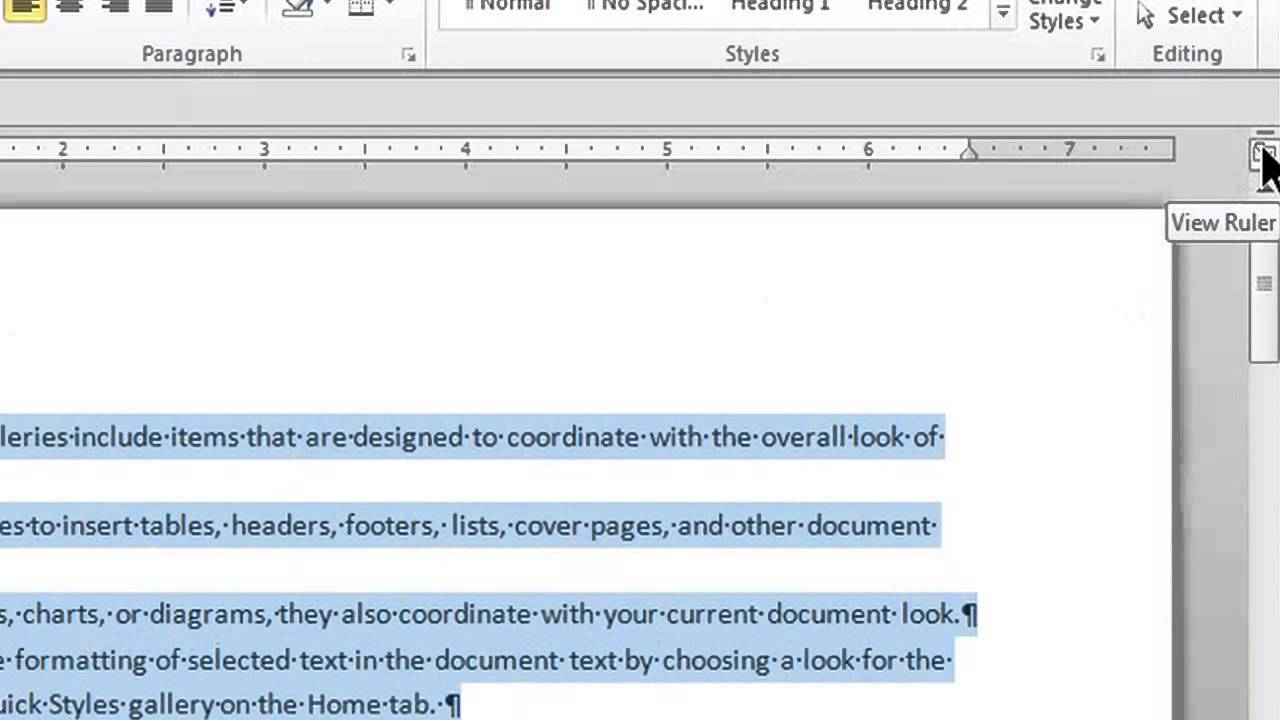
To display the ruler
- On the View tab, in the Show group, select the Ruler check box.
To indent or outdent the left edge of a paragraph
- Position the cursor anywhere in the paragraph, or select all the paragraphs you want to adjust.
Do any of the following:
On the Home tab, in the Paragraph group, click the Increase Indent or Decrease Indent button to move the left edge of the paragraph in 0.25” increments.
- Open the Paragraph dialog box. On the Indents and Spacing tab, in the Indentation area, set the indent in the Left box, and then click OK.
- On the ruler, drag the Left Indent marker to the ruler measurement at which you want to position the left edge of the body of the paragraph.
To create a hanging indent or first line indent
- Position the cursor anywhere in the paragraph, or select all the paragraphs you want to adjust.
- Open the Paragraph dialog box. On the Indents and Spacing tab, in the Indents area, click First line or Hanging in the Special box.
- In the By box, set the amount of the indent, and then click OK.
Or
- Set the left indent of the paragraph body.
- On the ruler, drag the First Line Indent marker to the ruler measurement at which you want to begin the first line of the paragraph.
To indent or outdent the right edge of a paragraph
- Position the cursor anywhere in the paragraph, or select all the paragraphs you want to adjust.
Do either of the following:
- On the ruler, drag the Right Indent marker to the ruler measurement at which you want to set the maximum right edge of the paragraph.
- Open the Paragraph dialog box. On the Indents and Spacing tab, in the Indentation area, set the right indent in the Right box, and then click OK.
Edit Space Between Bullet And Text Word 2016 Download
This chapter is from the book
Related resources
Edit Space Between Bullet And Text Powerpoint
- By Joan Lambert
- Book $24.99
Edit Space Between Bullet And Text Word 2016
- By Joan Lambert
- eBook (Watermarked) $19.99
Edit Space Between Bullet And Text Word 2016 Free
- By Paul McFedries
- Book $24.99