Go to on this page:
CROSSOVER MEASUREMENTSUp-Grade KITCROSSOVER LAYOUTSOUND
Re: XSim free schematic-based crossover designer program YAAAAAHHHHH!!! To anyone interested, this is a very useful XO tool. If you have any questions about using it, I don't mind trying to answer them. It's quite different than PCD. XSim is a 'free-form' Windows-based passive crossover design and simulation program intended to be as intuitive and non-restrictive as possible. The program is.free. for personal or commercial use. Any speaker builder with at least a basic understanding of what resistors, capacitors, and inductors do, and with decent response. The first is the power handling of those tweeters. I know you are using two, but those type of drivers do not handle power well in the lower range. The power divide is 400 Hz, and there is significant power below the crossover point even with a fourth order crossover. So the crossover needs to be raised to 600 Hz at least.
Google search reveals a multitude if finishes of the B&W 802.
A client brought in these B&W 802 s3 speakers for a possible upgrade of crossover. Not necessarily a new crossover, but at least a replacement of existing components with the best possible coils and caps within a decent price range, hence this article on how to up-grade your nineties B&W speakers.
Before starting any measurements I set up the speakers in my living room and replacing my ATS4, I experienced a somewhat smaller speaker with less visceral impact in the bass area and a somewhat less weighty lower midrange presentation, giving less fullness to vocals. After all, this is a smaller speaker and should be judged by that standard. I played music I knew well and I played some at really loud level and the 801 played it all without apparent distortion or sign of aggressiveness in any particular frequency band. I seems this speaker plays it all without being discriminating towards any particular type of music. I found the treble level well balanced, but some part of the midrange a little forward making vocals a little shut in like lacking the upper-mid/lower-treble.
Doing measurements of the 802 proved a surprising adventure, revealing quite an un-linear response as can be seen below, and I could understand my listening impressions, because around 1.5 kHz the overall level drops some 4-5 dB relative to the average midrange level. Hmm... The 802 midrange driver has quite a good dispersion and after a lot of tweaking and actually setting up a totally reworked crossover making an overall flat response, I started thinking the actual voicing appear deliberate rather than a result of poor engineering, although it looks so. Has to be said that all of the midrange and treble range from 1.5-20 kHz is fairly flat albeit at different levels. The roll-off of all drivers look really good with no apparent cone break-up problems at all. The actual crossover displays a 4th order topology with points of crossover ~475 and ~3300 Hz. Did I say I was impressed by the treble performance of this alu dome? Smooth and easy on the ear and not a hint of old time alu dome harshness.
Download 802 s3 manual here.
Before and after crossovers. Click images to vie large.
CROSSOVER
BACK TO INDEX
The crossover uses is an LR4 crossover topology realised from a third order filter to bass and tweeter and from second order filters for the midrange, the latter due to it's inherent roll-off characteristics. The coils are non-standard coils with regard to inductance and series resistance, but fortunately Jantzen Audio can deliver anything in this area.
I decided not to use air-cored coils for the bass section. 2.0 mH from 1.8 mm wire would still make DCR = 0.33 Ohm and 0.66 Ohm in total in series with the bass drivers. Too much, hence cored coils, but from thicker wire than the original crossover.
The new crossovers. Click images to view large
MEASUREMENTS
BACK TO INDEX
What seen above is the simulations and performances performed from as-is crossover and an experimental crossover, the latter producing a more flat response. The thing is the the 'perfect' crossover makes a too forward sounding speaker, too much right in your face. I link this to the overall power response being excessive in upper mid/lower treble from the 'flat' crossover due to dispersion of the small midrange driver. Sometimes this goes well, sometimes it doesn't, and the sad thing is that we're unable to predict this alone from the dispersion characteristics of the midrange driver. It must be tried and the overall voicing of a speaker system depends on listening tests of a wide range of musical genres trying to balance power response with a proper tonal balance.
You can obviously experiment with midrange attenuation if you find the speaker a little too forward.
Here you have what happens from R3 = 1.65 Ohm (default), 2.2 Ohm and 2.7 Ohm.
This nicely flattens the bump at 700 Hz without impacting upper-mid/lower-treble.
A single 10 watt resistor will do.
Above to the left: SPL from drivers measured at 0.5 meter distance with an input equal to 2.8V/1meter. Sensitivity of the bass drivers is around 87 dB, where the middriver is highly efficient with around 92 dB/2.8V. Tweeter level a little uneven, but around 87 dB possible due to the 10-20 kHz range. The small midrange cabinet makes a serious bump around 700-1500 Hz, not an easy response when it comes to crossover. Above to the right mid and tweeter with different scaling.
Above and below horizontal dispersion of tweeter and midrange driven directly without crossover. Both units display good dispersion, which may account for the need to suppress lower-treble range to balance the overall presentation. The midrange bump at 1 kHz poses a problem in terms of crossover design and not fully flattened out, puts its make on the overall voicing of this system.
Final results from up-graded crossovers.
Final results from the two speakers. Response within 1 dB.
Minor differences in performances from the two midrange drivers, but fully acceptable (one dust cap had been re-glued).
The before noticeable bump at 700-1000 Hz seems less prominent here. Maybe some of the old electrolytic caps had their time.
Final system impedance from the two speakers.
PICS from the workshop
All wires are replaced by 1.3 mm silver plated copper in Teflon sleeves. We can't replace than last 3-4 centimeters to the tweeter, but what's seen above will do. Make sure you get driver polarity right. Tweeter red is PLUS, tweeter blue is MINUS.
Above left: For the bass drivers the terminal to the right, when seen up-right, is PLUS (original yellow wire). Right: Midrange driver with the PLUS terminal to the right when seen up-right. Replace like seen above and ditch the connectors and solder wires directly to the terminals.
Left: The midrange driver is mounted with metric screws and a rubber grommet is inserted to reduce vibration. Nice details. Right: When you have pulled new wires through the hole to the bass cabinet, make sure adding a lot of filler to eliminate any ventilation to the bass cabinet. I used the same stuff as I use for mounting crossover. The mid cabinet is closed and completely filled with damping material. The midrange cabinet appear to be made from low-resonance material and is attached to the bass cabinet by a single threaded rod allowing wires to go through and the cabinet to be rotated. The latter may not be such a great idea as it allows the mid cabinet to rock slightly. Ideally insert a robber wedge at the rear between the two cabinets to reduce rocking once optimal position has been established.
Left: Removing the bottom panel with the crossover may take a little help from a 6 mm screw and a plier. Gently loosen the base plate. Right: To enable removing the bottom panel you have to cut the two fasteners holding the wires in place behind the bass drivers.
Left: Cut all wires from this terminal block, pull out the crossover and de-solder all wires including those from the binding posts.
The original crossover with electrolytic cap for the midrange and Bennic for the tweeter. Coils are not necessarily bad, but the midrange coils are not baked (backlack/self-binding wire) as should be to reduce vibration. New coils obviously are either baked or the tightly wound foil coils.
Pull out the rear middle section damping material and insert the bass crossover. Push up to the lower bass driver hole and fasten with two screws.
Above to the left the base plate holding the original crossover. The area that can be used for the new crossover is ~183 x 229 mm. To the right first time set-up of new crossover allowing me to AB test the two speakers. Quite a difference in sound I must say.
Above, left: The mid-tweeter section is the easy part. Connect input to terminals and connect mid and tweeter.
Above, right: Drill a 12 mm hole in the mid bracing through the lower bass hole to allow fastening one of the two screws holding the bass crossover to the rear panel. One the picture below to the left you can see the two screws in place.
Pull the wires to the bass drivers and insert 1/3 of the foam bar on top of the crossover.
The long foam bar from the center rear section is cut into three pieces and inserted from front through bass holes and the lower from the bottom.
Above to the left the terminals allowing bi-wiring. To the right wires soldered to the bass drivers.
Up-Grade KIT
BACK TO INDEX
There are some hidden information in the list below to avoid any dealer to do a copy-paste, and that's the series resistance of the coils. These need to be fairly accurate for some of the coils. For the bass coils I have chosen two coils with a lower series resistance compared to original. This doesn't impact sonics, but does increase power handling a little. The original tweeter coil uses very thin wire to reach desired DCR, where I have chosen to use a coil from thicker wire and add a series resistor to make the required total DCR. This coil is very important for the tweeter roll-off. I have added two resistors for possible tweeter attenuation. The 26 uF mid series capacitor is made up from 22+3.9 uF Superior-Z caps. I haven't made any middriver attenuation options, but should you want to try a slightly lower midrange level you may try 2.2 Ohm in replacement of the current 1.65 Ohm made up from 2 x 3.3 Ohm. It's not really necessary to use 20 watt resistors here. A single 10 watt resistor will do.
All kit and component prices may be subject to change and are always to be confirmed by Jantzen Audio Denmark.
Download Kit Sale Presentations:
All technical questions to troels.gravesen@hotmail.com
All questions regarding purchase of kits, please mail Jantzen Audio at contact@jantzen-audio.com
CROSSOVER-LAYOUT
BACK TO INDEX
I decided to split the crossover for the sake of space at the bottom and for getting the heavy bass coils as far away as possible from the midrange tweeter section. The bass crossover is placed as seen on photos in between the bracings behind the bass drivers.
Above crossover board for midrange and tweeter. I have added two optional resistors for tweeter attenuation, 0.47 Ohm or 1.0 Ohm. If you don't want to use these, connect C1 directly to the input point. See wiring below.
SOUND
BACK TO INDEX
I've already commented on the sound in the intro to this article and what you get from primarily replacing poor electrolytic caps for the midrange and mediocre BENNIC caps for the tweeter is significant increase in overall transparency and resolution. The compressed sound of the electrolytic caps is gone. What stood out from the new crossover was what I first experienced some 10 years ago when I first tried super caps, the initial confusing experience of music being darker and brighter at the same time. The resolution of super caps allows you to focus on individual aspects of the music in a way poor capacitors don't.
The ability of the speaker to reveal complex musical signals is enhanced. I obviously compared the measuring response of the original speaker to the new crossover and only found a slightly decrease in the 700-800 Hz bump from the new crossover, which is intentional and due to changed series resistance of L3, as the bump here in the very important midrange is noticeable from listening to the original speaker. I've tried not to change the fundamental voicing of this speaker as some of you may gotten used to this speaker from many years of service. Hope you enjoy the new crossover as much as I did.
Wiring
BACK TO INDEX
How to make a 3 way crossover?
Making a 3 way passive crossover design is pretty challenging. While a 2 way design is pretty straightforward, a 3 way crossover is several times more difficult to pull off. On the bright side, we do have intuitive computer software to help us out. XSim is one of my favorite apps for designing crossovers, and it’s completely free. In conclusion, I will show you how to use XSim to make a 3 way passive crossover design.
Xsim Crossover Manual
Methodology
First of all, let me introduce you to the device under test. Which is a 3 way floorstander using the following drivers (Amazon affiliate paid links) :

- Tweeter – Dayton Audio DC28F-8
- Midrange – Dayton Audio RS125-8
- 2 x Woofer – Dayton Audio SD215A-88
But before we do anything, we need the frequency response and the impedance measurement files. Also, we need to calculate the acoustic offset of the drivers. Here are some links to help you out :
Now that I have refreshed your memory, all you need to do is to create your FRD and ZMA files for each driver and calculate the acoustic offset between the drivers. When you are doing the frequency measurements, just do a gated far field measurement. You don’t need to do nearfield measurements. Why? Because it introduces phase errors when splicing nearfield with far field response. In addition, when you are designing a crossover, you don’t manipulate the lowest octaves. You just let the bass driver naturally roll off. It’s nice to have the whole response on the chart, but you can do it just as well without. As a result, we don’t need that portion of the frequency response (20 – 200 Hz), because we don’t alter it in any way in our 3 way passive crossover design.
3 way passive crossover design in XSim
As shown in the acoustic center article, place 3 speakers in parallel. Load the FRD and ZMA files for each driver. Apply the Hilbert Transform for each one. Apply the acoustical offset for the drivers which demand such effect. After you have done all of this, your board should look like this :
Next thing to do is to add some components to the circuit. Pro tip : use space to rotate components. A recommended place to start is to add 2nd order filters for each speaker, and then go from there.
- 2nd order low pass for woofer
- 2nd order bandpass for midrange. Which is a low pass and high pass added together.
- For the tweeter use a 2nd order high pass. Also, add a resistor to play with its value. Most of the time the tweeter is way more efficient compared to the rest of the drivers, and this resistor lowers its output.
Xsim Crossover Tutorial
Make sure all of the curves are showing on the frequency response chart. For the moment the combined response (blue line) is a mess. We will work on that. Another thing I would like to point out is that our chart extends only down to 100 Hz (this can be changed in the menu). I did this because we made gated far-field measurements of the drivers. As a result, the response is accurate 200 Hz and above. Bear this in mind, that the response between 100-200 Hz is not a good representation of reality. Let’s get to tinkering.
Woofer – midrange crossover point
First, we want to blend the woofer with the mid-range. Before we do anything, I noticed that the tweeter extends to 1 kHz and we need to address that. Decrease the value of the capacitor on the tweeter side to 1 uF. This will make sure that the tweeter doesn’t stick its nose into the lower octaves, where it doesn’t belong.
Just above, I gave some indications on which components to tinker with for achieving a good frequency summation between the woofer and the midrange. Also, keep in mind a good crossover point between the two. Since it’s a 3-way speaker, anything between 200-1000 Hz would seem a fair choice. So start fiddling with the components and try to reach your best response.
Xsim Crossover Design
Because we didn’t include the nearfield measurement in our FRD files, you will have to imagine that the response continues flat from 250 Hz and down. It actually rolls-off at around 50-60 Hz. So that looks pretty flat up until 1 kHz where we get a huge bump. According to the manufacturer specifications, the midrange has a flat response. However, we got this annoying bump. Since our speaker cabinet has rough, right angle edges and the speakers are not offset on the baffle, we have a nasty case of edge diffraction.
How to design loudspeakers - video courses
The hump is not near the crossover point and we cannot alter the slopes of the crossover to “cheat” this hump into disappearing where the 2 drivers meet. Instead, we will fix this issue later. When making a 3 way passive crossover design, you need to take care of the overall linearity, not just about crossover points. Speaking of which, the crossover point is at 460 Hz, where the 2 slopes intersect.
Mid-range – tweeter crossover point
The crossover point between the midrange and the tweeter is a bit more serious, because you can burnout the tweeter. But since this is a 3 way passive crossover design, there should be no problems in setting the crossover point a bit higher. So, something between 3 – 5k should be appropriate.
Fiddle with the components shown above and try to reach a nice integration between the tweeter and the midrange. In addition, keep in mind the crossover point, because the tweeter extends quite low with no intervention.
Don’t get to carried away with getting the response ruler flat because we have to fine tune everything anyway. As a result, when tinkering with one component, it can have minor effects in areas where you don’t expect.
Notch filter and fine tuning
We got to implement a notch filter on the mid-range side to get rid of that hump in the frequency response. After that, we will fine tune all the components until we get a flat response.
I can consider the crossover finished. The things that happened in the meantime :
- Added the notch filter on the midrange, to kill the hump.
- Reversed the polarity of the tweeter. You can do that to any driver as long as it’s in your advantage.
- Added a resistor in series with the parallel inductor on the tweeter side for better response shaping.
- Fiddle with all of the components till the response is close to flat.
I turned off the speaker curves to clearly observe the summed response. The speakers are not perfectly in phase. Many people look for that deep null at the crossover point when reversing the polarity of the midrange driver. You can do that by choosing asymmetrical crossover slopes to alter the phase shift and hope that the phases will match. I can tell you that I tried many combinations and didn’t quite got a satisfactory result. As a result a ladder delay network needs to be implemented and it will increase the cost of the crossover by quite some margin. I’m looking to keep the crossover price down, so I’m happy with just the flat response.
Impedance
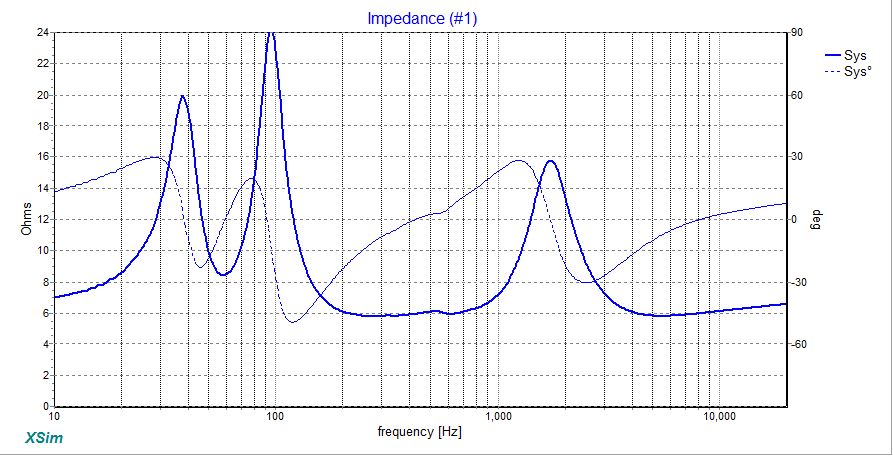
When doing a 3 way passive crossover design, impedance is also a factor. You need to keep an eye on that chart. Make sure it doesn’t dip too much under 4 ohms. On our graph it does dip at 1100 Hz. However, it’s on a narrow frequency band, and it’s on a high frequency (1 kHz), which is easy on the amplifier. Anyway, if you have a cheap amp and cannot handle this 3 Ohm load, you can increase the value of the notch filter resistor to keep this dip in check. However, the hump in frequency response we tried to kill, will slowly appear as you increase the value of the resistor.
Conclusion
It’s nice to have software like XSim. Even if you don’t know what you are doing, you can try stuff and see what happens. As you can see in our example, we started with a 2nd order topology on all drivers and we finished exactly as we started. But you can add more components to increase the order of the crossover if necessary. In a 2-way setup, most likely, the woofer only need 1st order filter, so less components. You need to adapt depending on your project.
References
- Image source : link.