- Garamond Font Mac
- Garamond Font Family
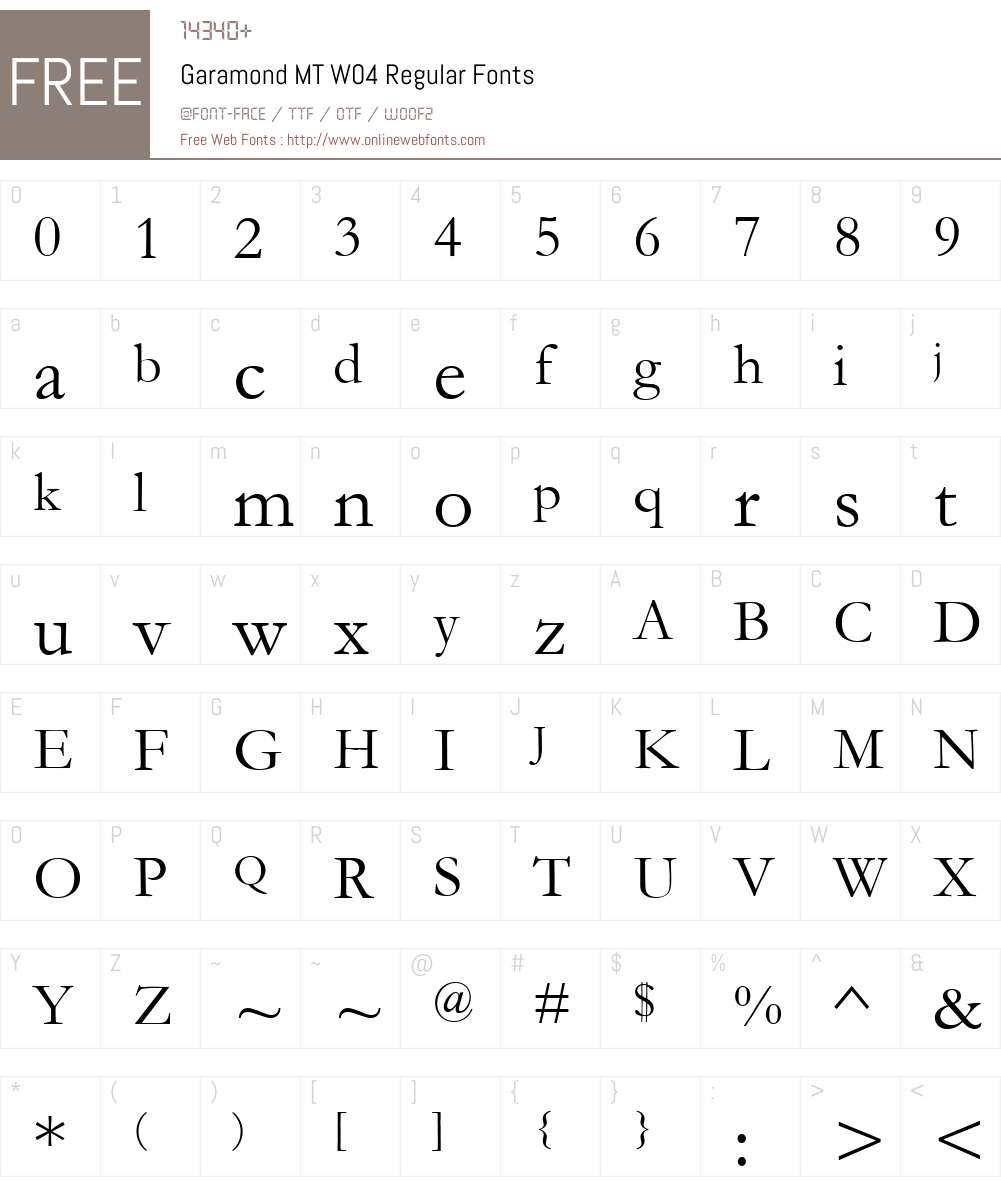
- Garamond Font Example
- Garamond Font Sample
- Garamond Font Download
What your preference says about you.
19 June 2020
Markus Spiske/Unsplash
From Times New Roman to Garamond to Cambria, many authors and editors have a preferred font. But does it make a difference when submitting a paper to a journal?
Discover and customize the font Apple Garamond and other similar fonts, ready to share in Facebook and Twitter. Garamond's types were, in turn, based on those used by Aldus Manutius in 1495 and cut by Francesco Griffo. The italic is based on types cut in France circa 1557 by Robert Granjon. Garamond is a beautiful typeface with an air of informality which looks good in a wide range of applications.
It’s true that a manuscript should be judged on its scientific merit, not on the way it’s presented. But it’s also true that a well-formatted manuscript is more likely to give a good first impression to an editor or reviewer.
Fonts tend to evoke passionate opinions, because appear to have personalities – from serious to comic or gothic. It’s possible that, consciously or not, readers might associate the font choice with the personality or intent of the author.
Jesse Meyer, a postdoctoral fellow at the University of Wisconsin-Madison, says he was “overwhelmed” by the heat it generated when he took the topic to Twitter.
The sans-serif font, Calibri, for example, was revealed to be particularly divisive:

Because calibri is ugly. Anything is >> calibri.
— Dr. Jessika (@famplanfan) April 30, 2020Calibri is evil- no idea who thought it should be the Word default font- to me, anything written in calibri screams “I just didn’t care enough to use a reasonable font”- HATE IT (and my lab will back ne up if anyone doubts my vehemence on this topic!
— Anita Corbett- VOTE EARLY (She/her) (@acorbe2) May 1, 2020I use Calibri default as it is the default so avoids any judgement on the font choice, but now I see that using the default creates judgement that I'm too lazy to change the font! 🙃
— Harriet Johnson (@harrietfjohnson) May 1, 2020Don't stand out for the wrong reasons
So, why is font choice so important to some people?
Kristina Gill, an archaeobotanist and archaeologist at the University of Oregon, believes that typeface should vary between formats.
Garamond Font Mac
For manuscript submission, she favours Times New Roman or Garamond, “which is a little more open and easier to read”. For presentations and posters, she prefers Calibri, which she says is easier to read at a distance.
Charlotte Flatebo, an applied physics PhD candidate from Rice University says “you can’t control how your research will work”, but you can control how you present your manuscript. “It’s a little piece of victory.”
For journal submission, don’t overthink it. It defies logic that a journal would reject a manuscript on the basis of typeface alone.
Garamond Font Family
Many journals have no specific requirements regarding format for submission, so if you prefer to write in a particular typeface – within reasonably standard fonts – it’s probably not going to hinder the likelihood of your paper being sent for review.
In fact, the common message from editors is that font choice doesn’t matter, unless it’s really noticeable.
“If your font draws attention to itself, it’s the wrong font,” says Andrew Bissette, senior editor at Communications Chemistry, a journal published by Springer Nature, which also publishes Nature Index. “Your reader should be thinking about your argument, not your presentation.”
Focus on formatting
It’s more important, says Bissette, to focus on “good paragraph structure, clear design of figures, and sensible spacing between lines and paragraphs”.
In other words, font choice is probably an unnecessary concern.
Garamond Font Example
Something that many journals do consider very carefully, however, is the type of font they publish in.
Historically, journals were read as physical copies; now, the vast majority of researchers read academic papers online. Trends in journal fonts clearly reflect this shift from print to digital.
For example, the new Nature typeface, launched in October 2019, was designed specifically for scientific writing, to accommodate the needs of technical content including equations, formulae and symbols while also optimizing readability on a small screen.
According to Nature creative director Kelly Krause: “We aimed for an overall impression of calm, rational intelligence with perhaps a dash of British formality and wit.”
So while the context of the writing can be an important consideration in typeface choice, for an individual researcher, it is mainly a question of personal preference.
Tags:
Garamond Font Sample
- GaramondStyle
Regular
CompanyMonotype Typography, Inc.
TrademarkMonotype Garamond is a trademark of Monotype Typography, Ltd which may be registered in certain jurisdictions.
CopyrightDigitized data copyright Monotype Typography, Ltd 1991-1995. All rights reserved. Monotype Garamond is a trademark of Monotype Typography, Ltd which may be registered in certain jurisdictions.
DescriptionMonotype Drawing Office 1922. This typeface is based on roman types cut by Jean Jannon in 1615. Jannon followed the designs of Claude Garamond which had been cut in the previous century. Garamond's types were, in turn, based on those used by Aldus Manutius in 1495 and cut by Francesco Griffo. The italic is based on types cut in France circa 1557 by Robert Granjon. Garamond is a beautiful typeface with an air of informality which looks good in a wide range of applications. It works particularly well in books and lengthy text settings.
LicenseNOTIFICATION OF LICENSE AGREEMENTThis typeface is the property of Monotype Typography and its use by you is covered under the terms of a license agreement. You have obtained this typeface software either directly from Monotype or together with software distributed by one of Monotype s licensees.This software is a valuable asset of Monotype. Unless you have entered into a specific license agreement granting you additional rights, your use of this software is limited to your workstation for your own publishing use. You may not copy or distribute this software.If you have any question concerning your rights you should review the license agreement you received with the software or contact Monotype for a copy of the license agreement.Monotype can be contacted at:USA 847-718-0400 UK 44(0)1737 765959For license terms and usage rights, please visit our web site at www.monotype.com/html/type/license.html Lizenzbedingungen und Nutzungsrechte finden Sie auf unserer Webseite www.monotype.com/html/type/license.htmlPour plus d'informations concernant les droits d'utilisation et les questions contractuelles, veuillez consultez notre site www.monotype.com/html/type/license.htmlPara obtener informacin acerca de los trminos de licencia y los derechos de uso, visite nuestro sitio en el Web en www.monotype.com/html/type/license.htmlPer le condizioni contrattuali ed i diritti d'uso, visitate il nostro sito web all'indirizzo www.monotype.com/html/type/license.html
RegularClaude Garamond - StempelStyle
Regular
TrademarkDJ ZAI 2011 zai.tomasz.skowronski@gmail.com All rights reserved.
CopyrightDJ ZAI 2011 zai.tomasz.skowronski@gmail.com All rights reserved.
RegularClaude Garamond - Stempel Garamond W04 BoldStyle
Bold
CompanyLinotype GmbH
TrademarkStempel Garamond is a trademark of Linotype GmbH and may be registered in certain jurisdictions.
CopyrightCopyright 1981 - 2011 Linotype GmbH, www.linotype.com. All rights reserved. This font software may not be reproduced, modified, disclosed or transferred without the express written approval of Linotype GmbH. Stempel Garamond is a trademark of Linotype GmbH and may be registered in certain jurisdictions. This typeface is original artwork of D. Stempel AG. The design may be protected in certain jurisdictions.1988, 1993, 1995, 1998, 2002 Adobe Systems Incorporated. All rights reserved.
DescriptionClaude Garamond (ca. 1480-1561) cut types for the Parisian scholar-printer Robert Estienne in the first part of the sixteenth century, basing his romans on the types cut by Francesco Griffo for Venetian printer Aldus Manutius in 1495. Garamond refined his romans in later versions, adding his own concepts as he developed his skills as a punchcutter. After his death in 1561, the Garamond punches made their way to the printing office of Christoph Plantin in Antwerp, where they were used by Plantin for many decades, and still exist in the Plantin-Moretus museum. Other Garamond punches went to the Frankfurt foundry of Egenolff-Berner, who issued a specimen in 1592 that became an important source of information about the Garamond types for later scholars and designers. In 1621, sixty years after Garamond's death, the French printer Jean Jannon (1580-1635) issued a specimen of typefaces that had some characteristics similar to the Garamond designs, though his letters were more asymmetrical and irregular in slope and axis. Jannon's types disappeared from use for about two hundred years, but were re-discovered in the French national printing office in 1825, when they were wrongly attributed to Claude Garamond. Their true origin was not to be revealed until the 1927 research of Beatrice Warde. In the early 1900s, Jannon's types were used to print a history of printing in France, which brought new attention to French typography and the Garamond types. This sparked the beginning of modern revivals; some based on the mistaken model from Jannon's types, and others on the original Garamond types. Italics for Garamond fonts have sometimes been based on those cut by Robert Granjon (1513-1589), who worked for Plantin and whose types are also on the Egenolff-Berner specimen. Linotype has several versions of the Garamond typefaces. Though they vary in design and model of origin, they are all considered to be distinctive representations of French Renaissance style; easily recognizable by their elegance and readability. First released by D. Stempel AG in 1925, Stempel Garamond was based on the Egenolff-Berner specimen of 1592 and was therefore a revival of the genuine Garamond types. It is one of the most famous Garamond interpretations, and since its introduction in 1925, it has been one of the most frequently used text fonts. Stempel Garamond has its own unique temperament, with a rhythm and sharpness that set it apart from other Garamonds. Stempel Garamond is available in several weights with small caps, Old style Figures, and Central European characters.
BoldD. Stempel AG - Stempel Garamond W04 RomanStyle
Roman
CompanyLinotype GmbH
TrademarkStempel Garamond is a trademark of Linotype GmbH and may be registered in certain jurisdictions.
CopyrightCopyright 1981 - 2011 Linotype GmbH, www.linotype.com. All rights reserved. This font software may not be reproduced, modified, disclosed or transferred without the express written approval of Linotype GmbH. Stempel Garamond is a trademark of Linotype GmbH and may be registered in certain jurisdictions. This typeface is original artwork of D. Stempel AG. The design may be protected in certain jurisdictions.1988, 1993, 1995, 1998, 2002 Adobe Systems Incorporated. All rights reserved.
DescriptionClaude Garamond (ca. 1480-1561) cut types for the Parisian scholar-printer Robert Estienne in the first part of the sixteenth century, basing his romans on the types cut by Francesco Griffo for Venetian printer Aldus Manutius in 1495. Garamond refined his romans in later versions, adding his own concepts as he developed his skills as a punchcutter. After his death in 1561, the Garamond punches made their way to the printing office of Christoph Plantin in Antwerp, where they were used by Plantin for many decades, and still exist in the Plantin-Moretus museum. Other Garamond punches went to the Frankfurt foundry of Egenolff-Berner, who issued a specimen in 1592 that became an important source of information about the Garamond types for later scholars and designers. In 1621, sixty years after Garamond's death, the French printer Jean Jannon (1580-1635) issued a specimen of typefaces that had some characteristics similar to the Garamond designs, though his letters were more asymmetrical and irregular in slope and axis. Jannon's types disappeared from use for about two hundred years, but were re-discovered in the French national printing office in 1825, when they were wrongly attributed to Claude Garamond. Their true origin was not to be revealed until the 1927 research of Beatrice Warde. In the early 1900s, Jannon's types were used to print a history of printing in France, which brought new attention to French typography and the Garamond types. This sparked the beginning of modern revivals; some based on the mistaken model from Jannon's types, and others on the original Garamond types. Italics for Garamond fonts have sometimes been based on those cut by Robert Granjon (1513-1589), who worked for Plantin and whose types are also on the Egenolff-Berner specimen. Linotype has several versions of the Garamond typefaces. Though they vary in design and model of origin, they are all considered to be distinctive representations of French Renaissance style; easily recognizable by their elegance and readability. First released by D. Stempel AG in 1925, Stempel Garamond was based on the Egenolff-Berner specimen of 1592 and was therefore a revival of the genuine Garamond types. It is one of the most famous Garamond interpretations, and since its introduction in 1925, it has been one of the most frequently used text fonts. Stempel Garamond has its own unique temperament, with a rhythm and sharpness that set it apart from other Garamonds. Stempel Garamond is available in several weights with small caps, Old style Figures, and Central European characters.
RomanD. Stempel AG
Garamond Font Download
- Stupefaction V1
- achille nzodaStyle : Regular
- P22 Victorian W00 GothicStyle : Regular
- Quire Sans W01 ThinStyle : Regular
- Berylium bold V2Style : bold
- Velveteen Round NF W01 RegularStyle : Regular
- Ubuntu Light ItalicStyle : Light Italic
- LTC Goudy Oldstyle W01 BoldStyle : Regular
- logoskateStyle : Regular